Antonio
Elena KnowsAntonio, Elena’s deceased husband and Rita’s father, remains present in the novel through the beliefs, rules, and recollections he left within his family. A practicing Catholic who worked at Sacred Heart Catholic School as both porter and theology teacher, he stands in contrast to Elena’s concealed disbelief and helps explain the uneven religious inheritance shared by his wife and daughter. His death after a heart attack also becomes a practical memory: the ambulance summoned through PAMI arrived too late, leaving Elena and Rita reluctant to seek help from the public service afterward.
Identity and Family
Antonio was Elena’s husband and Rita’s father. He practiced Catholicism and worked at Sacred Heart Catholic School, where he was employed not only as a porter but also as a theology teacher. His religious commitments were therefore part of his daily work as well as his place in the family. The novel does not present him through a sustained account of his life; instead, Elena’s recollections disclose how his views shaped the household and continued to influence its members after his death.
Elena had never fully shared his belief in the soul or in eternal life, but she had not dared to admit this to him. She imagined that Antonio would have been unable to understand her disbelief and would have been upset to learn that his wife, the mother of his child, did not believe in an afterlife. Her silence indicates how his faith set terms for what could be openly discussed between them. After his death, the contrast between his conviction and her private skepticism also offers Elena a way to understand Rita’s mixed relationship with religion: Rita had been raised by one fervent Catholic parent and another who only appeared to believe.
Faith and Household Influence
Rita’s religious life did not simply reproduce Antonio’s practice. She wore a cross and observed many Catholic customs, including fasting and attending several churches on Good Friday, yet she also skipped Mass when it rained because she feared lightning. She did not follow every religious expectation consistently, and Elena remembers her as having assembled a personal faith from selected practices and private rules. The family’s religious inheritance thus appears less as a single settled doctrine than as a tension between Antonio’s committed Catholicism, Elena’s concealment, and Rita’s selective observance.
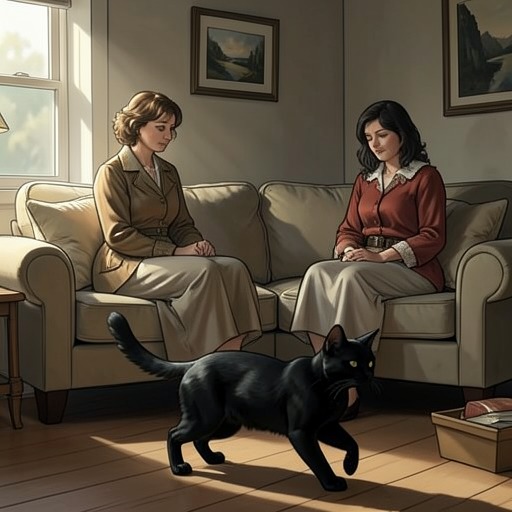
Antonio’s authority also shaped the family’s domestic life. Rita once hid a kitten in a box beneath her bed and secretly fed it milk, but Antonio would not allow her to keep a cat. He warned her about illnesses and other harms associated with cats, and Rita eventually repeated his negative view of them. Elena cannot tell whether she herself disliked cats or whether she learned to think of them that way within the household. What she can identify is the lasting rule: there had been no cats in their home because Antonio forbade them, and Rita later inherited the authority to maintain that prohibition.
That inheritance surfaces when Elena visits Isabel and encounters Isabel’s cat. The animal’s persistence brings back the remembered exchange between Antonio and Rita, including the way his warnings became part of Rita’s own language. Elena considers whether she might like touching the cat, but the family’s old judgments intervene; she pushes it away rather than continue the encounter. Antonio’s influence is therefore not limited to a remembered opinion. It lives on as a reflex that shapes what Elena permits herself to do, even in a home that is not hers.
Death and Its Practical Consequences
Antonio died of a heart attack at home, where Elena now lives alone. Elena and Rita waited for a PAMI ambulance for more than an hour while he lay on the kitchen floor. It arrived five minutes after he had died. Elena remembers the siren approaching, but by then she knew that the ambulance could not help him. The delay gives their later reluctance to turn to PAMI a specific history: it is connected not simply to generalized mistrust, but to an emergency in which they sought help and received it too late.
That memory reappears when Elena and Rita face growing costs and restrictions in securing care for Elena. They have avoided even discussing PAMI since Antonio’s death. The earlier failure consequently bears on a later caregiving problem, connecting his death to the practical choices his family makes as Elena’s illness progresses. Antonio is no longer present to participate in those decisions, but the experience of waiting for assistance remains part of their understanding of public medical care.
Posthumous Presence
Antonio’s characterization is built through Elena’s recollection rather than through scenes of his present-day life. His remembered words and prohibitions persist in the minds of both women, but not identically: Rita repeats his judgments about cats, while Elena recognizes the influence and struggles to separate it from her own preferences. At Isabel’s home, Antonio and Rita seem to speak again in Elena’s thoughts, making family memory an active pressure on her response to the cat. The moment shows how an inherited rule can outlast the person who established it, while also allowing Elena to notice that inheritance and her own desire do not necessarily coincide.
His religious legacy is similarly unsettled. Antonio’s committed Catholicism helps define the faith Rita inherits and the belief Elena keeps hidden, but neither woman simply becomes a copy of him. The novel places his influence alongside the consequences of his death and the family’s later experiences, rather than reducing him to a single explanation for their choices. He remains significant as a husband and father whose convictions and household authority survive as remembered habits, even as Elena and Rita negotiate their own relationships to faith, care, and everyday life.